Read, write, and receive premium articles, reader support, and much more!
Join Prof.Peter Paper Trails ★
Jolly of the Folly: Revaluing the Observing Ego Over Systemic Illusions
Inspired by Desiderius Erasmus, this psychological inquiry challenges the rigid "logic trap" of modern polarization.

Revaluing the Observing Ego Over Systemic Illusions
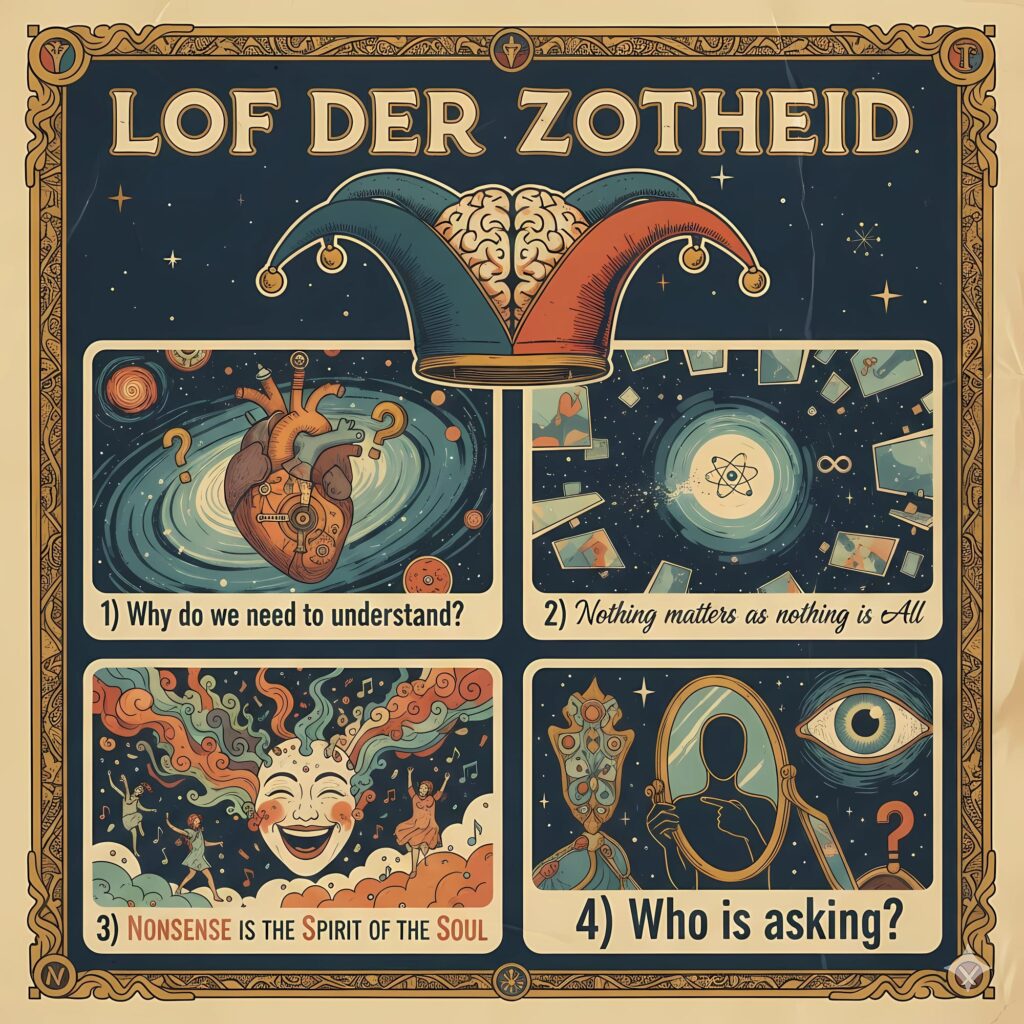
As a practicing psychologist and admirer of Desiderius Erasmus, “In Praise of Folly” is my visual tribute to his timeless exploration of the human psyche. The subtitle, “A Wink from the Jolly of the Folly,” marks the starting point for an investigation where embracing “folly” serves as a liberating force and critical lens to comprehend modern mental well-being.
Thematic Exploration: The Narcissistic Pitfall. This artwork connects historical satire with direct commentary on contemporary life. Its core idea is that our life journey can often be reduced to the futile “search for arguments to bite our own tail.” In our current age, this manifests as an omnipresent narcissistic pitfall of polarization: we place ourselves at the center of wisdom, entangled in our own righteousness, and label all others as caricatures or villains. The absurdity of this becomes apparent when we realize that such division mostly imprisons our own minds.
The Four Panels: A Psychological Inquiry
- The Affective Domain: “Why do we need to understand?” challenges pure logic and highlights the irrational power of emotion in our decision-making.
- Systemic Complicity: “Nothing matters as nothing is All” examines our tendency to embrace systemic illusions.
- The Catharsis of Nonsense: “NONSENSE IS THE SPIRIT OF THE SOUL” speaks to humor as a vital valve in rigid ideological struggles.
- The Observing Ego & Delusion: “Who is asking?” demands that we confront our own delusions rather than project them onto others.
Intention & Impact I intend to build a bridge between historical satire and urgent psychological insight. True mental health requires embracing the liberating power of absurdity and celebrating the jolly folly of the human condition. We can only break through polarization by taking a playful, self-critical look at our own role in the spectacle.
Artist Statement: A Wink from the Jolly of the Folly
This visual triptych serves as a psychological mirror, reflecting the modern tendency toward intellectual rigidity and the “narcissistic pitfall of polarization.” Inspired by Desiderius Erasmus, the work posits that our greatest mental prison is the insistence on our own absolute rightness. By elevating Folly from a defect to a liberating virtue, the piece explores how absurdity can dismantle the ego-driven walls we build between “us” and “them.”
The Architecture of Absurdity
At the center of the composition sits the Brain in the Jester’s Cap, a symbol of the “Jolly of the Folly.” It suggests that true wisdom is not found in solemnity, but in the realization that our most complex cognitive architectures are often just elaborate costumes for our primal impulses.
The Four Pillars of Inquiry
| Panel | Domain | Psychological Insight |
|---|---|---|
| 1) Why do we need to understand? | The Affective | A challenge to the “Logic Trap.” It highlights how we use intellect to justify emotional impulses, essentially “biting our own tails” to prove we are right. |
| 2) Nothing matters as nothing is All | The Systemic | An exploration of complicity. We often lose ourselves in systemic illusions, forgetting that the “grand designs” we fight over are often projections of our own void. |
| 3) Nonsense is the Spirit of the Soul | The Cathartic | Humor as the ultimate defense mechanism. In a polarized world, the ability to embrace the nonsensical is the only way to remain “liquid” and avoid ideological calcification. |
| 4) Who is asking? | The Observing Ego | The final confrontation. It demands we turn the lens inward, shifting from criticizing the “other” to questioning the validity and biases of the “self.” |
The Narcissistic Pitfall
The artwork critiques the contemporary phenomenon where individuals place themselves at the center of a moral universe. In this state, we become trapped in a loop of self-validation—a “narcissistic pitfall”—where we view the world through a binary lens of heroes and villains.
“We can only break through polarization by taking a playful, self-critical look at our own role in the spectacle.”
Final Intent
This piece is an invitation to relinquish the burden of being right. By celebrating the inherent “folly” of the human condition, we find a bridge back to empathy. To embrace nonsense is not to lose one’s mind, but to find one’s soul in a world that has become dangerously serious.
SYSTEM NOTICE & DISCLAIMER
Prof. Peter exercises the utmost care; all articles, research, and source documents are authentic unless explicitly stated otherwise.
None of the publications shall be interpreted as medical, psychological, or professional advice; they aim to provide profound insights rather than absolute truths.
In case of dispute, please email mohd@profpeter.online and we will sort it out in good faith.
Visually, this space is supported by custom illustrations created by Banana Pro, alongside digital conceptual AI aids.