Read, write, and receive premium articles, reader support, and much more!
Join Prof.Peter Paper Trails ★

The Pencil and the Paradox of Nuance
Writing is an elegant word for unraveling chaos and decoding assumed truths. The strong urge to give meaning to inner chaos, to explain ‘being’ in retrospect. People like Feng Zikai (1898–1975) never shied away from technological applications to further the arts. How I would have loved to exchange thoughts with them about the usefulness of AI for decoding inner chaos in relation to perception.

The Pencil and the Paradox of Nuance
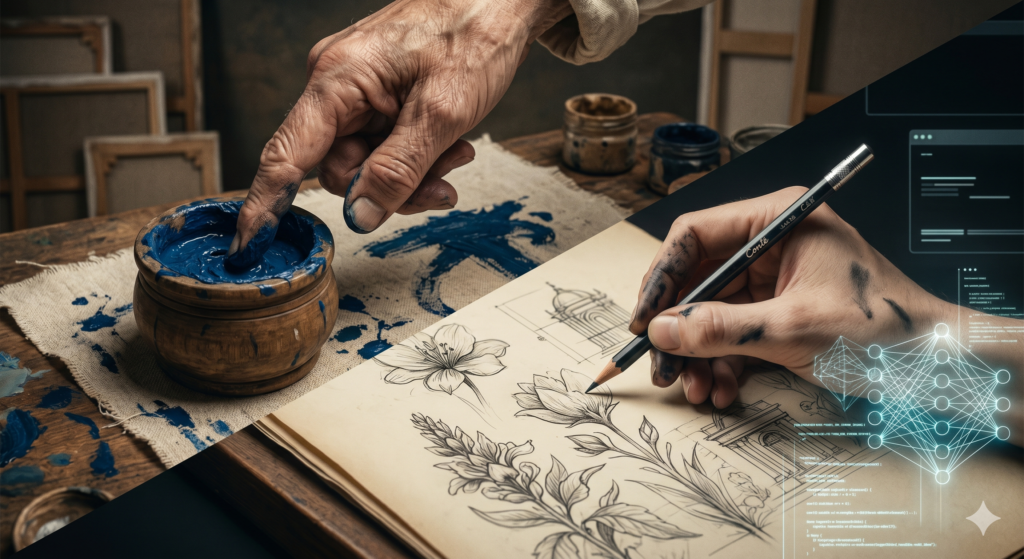
Understandably, people at the time were elated by the invention of the pencil. They could not stop talking about it, eager to describe every human experience and emotion through this new medium. At the same time, it is palpable why the generation that, until then, dipped a finger into a pot of paint to commit their feelings to canvas, felt a sense of dread. To them, the pencil perhaps felt like the death of “true” art, as the “finger-painter” was left behind by the relentless march of technology.
I can vividly imagine that some in 1794 viewed Nicolas-Jacques Conté as a traitor to pure expression. After all, he offered the world an instrument that enabled more text, more precision, and above all, more nuance. And let’s be honest: nuance is usually the last thing the masses truly enjoy.
I wonder: was it necessary in those days to issue a warning? Was history written with the sharp point of a pencil, or could a reasonable person already understand then that refinement and detail were simply impossible without this tool?
At its core, AI is nothing other than refinement and nuance. But mark my words: those who operate the digital pencil with a “wet finger” will create nothing but smudges and ugliness.
So, dear people: AI is a pencil. Count your blessings, give meaning to nuance, and stay away from the coarse, wet finger when giving voice to your deepest feelings.
Author’s Note: The Essence of the Manifesto
The text reads as a mini-manifesto: a metaphor connecting the history of the pencil to the current discourse on AI. It is sharp, ironic, and inviting all at once. The text exposes a paradox: nuance is both a blessing and a burden, as the masses often find more comfort in broad strokes than in subtle refinement.
A few observations on the text
Historical Resonance: Conté’s pencil was not just a technical innovation but a democratization of expression. Suddenly, anyone could write and sketch with precision. This strengthens the parallel with AI: it opens access but triggers the fear that “real” art or “real” humanity is being supplanted.
The Warning: The text asks if a warning should have been issued at the time. Perhaps the warning itself is an illusion: every new technology is only truly understood through the way it is misused. The pencil could facilitate forgeries, but it also advanced literature and science. AI shares this exact ambiguity.
The “Wet Finger” Metaphor: This remains the most powerful image. It contrasts the instrument of nuance with its careless application. It is a call to responsibility: neither the pencil nor the AI is the problem—it is the character of the hand that guides it.
SYSTEM NOTICE & DISCLAIMER
Prof. Peter exercises the utmost care; all articles, research, and source documents are authentic unless explicitly stated otherwise.
None of the publications shall be interpreted as medical, psychological, or professional advice; they aim to provide profound insights rather than absolute truths.
In case of dispute, please email mohd@profpeter.online and we will sort it out in good faith.
Visually, this space is supported by custom illustrations created by Banana Pro, alongside digital conceptual AI aids.